New York
When John last wrote we were working in northern New York, aka the North Country. On March 1st we packed up and left, reluctantly leaving behind friends & relatives, jobs, a cozy (if tiny) apartment and all that magnificent snow-covered scenery. We spent a hectic week on Long Island at my parents’, packing, shopping for boat things and visiting people--apologies to my parents for not visiting with them properly!-- and John went to Ohio for a few days to see his own relatives. We also tried hard to sell a very used car.The car--actually, it was more of a truck--story deserves telling. This was the 13 year old Toyota 4Runner we’d bought last November to take north. The guy who sold it to us was a Long Island cop who’d only owned it for a month or so and who swore the fresh bloodstains in the truck bed were from a deer he’d shot. But despite these, er, red flags and the truck’s rather advanced age, it ran perfectly well (if you ignored the lousy mileage) and we were happy with it. In fact, in four months of heavy commuting in the most challenging winter conditions imaginable, that truck did a lot more for us than we gave back. I confess I personally drove it into one or another of the trees on our icy, unpaved driveway at least three times, and one time the driver’s side door was badly dented by a deer crossing the road (revenge, possibly?). Needless to say, selling the car was going to take some finesse. We worked on the ad copy for some time, trying to get at that car buyer magazine je ne sais quoi, and after several false starts came up with something like this: "86 4Rnr rd rem-tp 4c efi 115k ps db aw cd and several very large dents".
There were a few bites. We got the first call the day we arrived at my parents’ and it was a fair indicator of things to come. (It’s a good thing, incidentally, that my parents themselves were away at the time. The fact that we’d advertised in free car buyer weeklies whose distribution reached metropolitan New York meant a potentially huge number of strangers descending on the Newton household--it would take time to warm my parents to this concept.) The first call came from somewhere just outside the city, the language an indeterminate foreign tongue with English words tossed in here and there for emphasis. I answered the caller’s questions as best I could, though he was fairly impatient with me. After some discussion we arrived at several conclusions, namely that I had a car to sell, that he wished to buy a car much like the one I was selling, and that he thought our asking price of $2000 offensive. "But we’ve listed it as $2000 firm, can’t you see that in the ad? You don’t have to buy it!" I insisted, but he indicated that he would come see it in spite of my folly and we would, perhaps, work something out. The best part of the conversation was when he asked for directions. As they began to get complicated I could tell he had stopped taking notes, and suddenly he announced, in surprisingly good English,"I tell you: you will bring car to me!" Eventually he did make his way to us, accompanied by his brother, and they barely glanced at the truck before starting in on the haggling process. When we wouldn’t, they left. This, as I say, was a pretty representative example of our luck, and when we’d still had no success a week later, we arranged for John’s mother & stepfather to keep the truck. (This way we can use it again next time we work in the U.S. and in the meantime it will have a loving home.)
Golfito, Costa Rica
We flew back to San Jose, Costa Rica on March 10th. There we met two friends we’d invited to sail with us, Barak and Melissa, and proceeded south to the sweltering but pleasantly situated gulfside town of Golfito, temporary home to Saros (remember her?). We arrived with high hopes for coastal sailing but within a day or so saw that a broken shaft seal would force a change of plans. This news was accepted graciously by our guests, and with considerably less equanimity by ourselves. Fortunately, things worked out possibly even for the better, as the helpful staff at Land-Sea Services (who’d been looking after Saros) redirected us toward can’t-miss tourist activities like jungle lodges and safaris, ocean kayaking, and surfing--beginner’s surfing, anyway. Melissa turned out to be quite the birder, to the edification of the rest of us. We became so engrossed in bird-watching on one hike that we almost collided with a sleeping fer-de-lance (which, by the way, blinds in 30 minutes and kills in hours). On a similar note, we won’t soon forget the look on a fellow tourist’s face at one rather pricey resort when he discovered a scorpion crawling on his leg. (We probably wore similar expressions after learning at that same resort that the mosquito netting over our beds--the netting we’d neglected to use--offered protection not from mosquitos at all but from falling scorpions who’d been nesting in the palm-frond roof above us.)
The best news of all was that John was somehow spared the necessity of diving underneath the boat for the reinstallation, despite early predictions to the contrary. Now normally, as you have seen, we are willing to get a little wet for the sake of a boat repair, but here the water quality presented a slight problem. For most residents of Golfito, sewage management consisted in using the bay as a giant toilet bowl: everything from dinner scraps to paper trash to broken furniture to, como no?, toilet waste and even soiled diapers was dumped directly into it and handily flushed out into the gulf with the turning of the tide. What this meant for the possibility of enjoying a swim off the side of the boat was: what are you crazy??? Now it happened that, as one U.S. expat put it, there existed a moment shortly before high tide when the water was "almost inviting." John, realizing a dive would probably be necessary (to prevent the bay and all its contents from entering Saros during the shaft seal replacement), thought he’d wait for just that moment. Meanwhile, unaware of John’s preferences, the mechanic had arrived at that point in his repairs where John’s presence underneath the boat was desired. John tried to protest--mind you, the tide was now in full ebb--but I thoughtfully suggested he at least look at the water before rejecting the idea completely. He did, and was back in half a second with the suggestion that I might also like to have a look! Peering reluctantly at the water, I couldn’t help but see what had grabbed John’s attention, the thing that put an end to even the most hypothetical idea of getting into this foul water: perched atop a large, hideous, yellow-brown slick of unmentionably awful scum, nestled in the evil substance’s exact center as if it belonged there, was the lid of a toilet. The installation of the shaft seal was completed without John’s assistance.


The other major mechanical failure announced itself exactly seven minutes after we weighed anchor on April 2nd, in our first attempt to leave Costa Rica. There we were, our paperwork cleared with Customs, fuel and water tanks freshly filled, the pantry overflowing with food, and only one day past our scheduled departure date! Something had to go wrong, and mercifully we didn’t have long to wait for it: a copper coolant pipe sprang a leak and the engine temperature soared. Cursing and threatening to throw the engine overboard--we are becoming so familiar with this particular rant that we may well make good on it some day!--we made our way back to our little corner of Golfito’s harbor, ordered a new coolant pipe and a spare for good measure, and hopped a bus for Panama for a few days’ escape. (We are fond of Panama for several reasons, among them the city of David, where we can see new American movies for $1.50, stay in a nice hotel for $15, and buy high-quality goods, also at reasonable prices. Of course, there are plenty of other things to like about Panama: the people are friendly, the vegetable markets excellent, the countryside lovely, and, best of all, the tourists not yet present in overabundance--shhhh, don’t tell anybody!--except in the Canal Zone.)
We got our replacement coolant pipes, but that in itself is a story. (If you’re wondering, by the way, why we didn’t just ask our "excellent mechanic" to make one for us, he did try but it turned out the pipe ends were of the "press-to-fit" type, making duplication of the exact shape essential, and next to impossible, so we turned instead to the source, Volvo.) This package was the third of three we’d had to wait for, and in the process of all the waiting we did we became very cranky about Costa Rica’s handling of imported goods. We already knew that importation duty could be so enormous that those wishing to use foreign cars or boats invariably go to extreme lengths to move their vehicle out of the country periodically so as to technically avoid "importing" it at all. We knew also that even small packages from out of the country are typically held in Customs for indefinitely long periods, and then taxed to the tune of 70%! We were aware, though, that in most countries, cruising sailors legally avoid such taxes by labeling imported boat parts as "Parts for Yacht in Transit." Our first package and importation experiment, a new PVC water tank, cost us $50 in import duty, plus nine days’ waiting, to import via DHL; the tank itself had cost under $70. In investigating the possible cause of this failed experiment, we learned that the "Parts for…" label had been omitted by the sender. Confident of success the second time around, we urged the sender of our combination sun-awning/rain-catcher to remember the label. She did, and again we waited over a week and were charged the 70% duty!
At this point, we were equally put out by the expense and the slowness of package delivery in Costa Rica. For delivery #3, the coolant pipes, we followed some radical advice and had the package sent via the U.S. Mail (Express Mail) instead of DHL. It is just possible that this method would have worked, in fact it came very close to working, but for one chance occurrence: the postmaster in San Jose was struck with an inexplicable curiosity as to the precise contents of the little package we were waiting for, intriguingly described by the U.S. Postal Service as "copper pipes." His exact words (I had the privilege of speaking with him in person later): "I ask myself, ‘Pipes? Pipes is not going to a family. Pillows is going to a family. Pipes maybe is for drogas.’" And so he set the package aside for Customs inspection, and there it sat for over a week until someone thought to notify the Golfito P.O. that it was there. The very sympathetic local post office staff expressed dismay as they told me the situation, and it was soon clear that I would have to go to San Jose myself to see what was up.
I was so relieved, though, finally to be able to take matters into my own hands that I actually had a lovely time on my little excursion to San Jose. The flight there was interesting. The plane was a tiny 12-seater, deftly flown over gorgeous scenery by two women who both looked about 18, one of whom I’d taken to be a flight attendant as she collected my ticket. They both had cute, bouncy little ponytails, big earrings and lots of make-up, and both chewed gum! I might not have noticed them at all, deeply absorbed as I was in Patricia Highsmith’s "Strangers on a Train," but the two sixty-something sportfishermen in front of me couldn’t stop staring and making cautious little comments about them. "My," said one, "Those are very young ladies flying this plane, did you notice that?" "They’re doing just fine now, aren’t they, yessiree," said the other. Their observations, and my own, disturbed me at first. I recalled how transparently sexist it seems when older patients in the emergency department continually remark on how young I am for a doctor, though I am actually several years older than most of the house staff and almost a decade older than some of the students. I strongly suspect the male physicians don’t hear this comment nearly so often, because what it typically means is really how young and female I am. (As one octagenarian put it, on meeting me, "Well well, a little girl doctor!") Am I therefore sexist myself, in being surprised at who I found flying the plane? Possibly I am, if girlishness--in the form of ponytails, etc.--failing to inspire my confidence is the same as sexism. However, it is unlikely that boyishness in pilots (baseball T-shirts, cowlicks, rough language and more gum-cracking) would fare any better with me. More likely, what I was noticing about them was not their being female (and young) but their being childish-looking--lacking the sophistication we expect from professionals. This distinction would probably be lost on the two gentlemen in front of me (and on some of my patients), but now you will say I’m being ageist! In any event, the two very-young women handled the plane just fine, and this in itself is remarkable because, as I learned afterwards, the more experienced pilots in Costa Rica fly the bigger planes; the smaller ones are flown by the junior pilots, you know, for practice.
In San Jose I had all of four hours before the last flight back to Golfito, so I planned accordingly. First I claimed my package, paid a very small sum to Customs (under a dollar), and had a brief chat with the man, quoted above, who’d decided to detain the package. I was so grateful at not having to pay a 70% tax--in that sense, this delivery had been a success, leaving aside the matter of the roundtrip airfare--that I managed to hold my tongue when "drogas" were mentioned, and departed without offering my opinion that the odds of finding drugs in a package mailed from a Volvo distributor in the U.S. to an American in Central America were actually quite slim. Next I found myself a wonderful cabdriver who happened also to be a mecanico and took me to San Jose’s own Volvo distributor to look for a new starter. (Maybe I forgot to mention it: our starter had recently signaled a request for replacement.) There I had a very nice surprise indeed. It just so happened that there was one Volvo MD11C starter in stock, and this lonely little starter had lain forgotten on a shelf in this store for eighteen years, all the while bearing its original price tag. The cabdriver had the pleasure of translating this news to me--I really do speak Spanish, but I still have quite a time understanding it!--and he was positively beaming when he told me it would cost me a mere $100 (the current price is more like $800 or $900). I filled the last hour getting my hair cut, then headed back to Golfito, this time in the capable hands of a little girl pilot and a little boy co-pilot.
Around that time, we found ourselves unaccountably ready to leave again, all packages having been safely received, all repairs completed, and John’s 4-day bout with fever, chills and joint aches diagnosed at the local hospital as a mild virus (complete blood count and thick smear were fortunately both normal). On April 20, still only a mere three weeks past our scheduled departure date (longtime followers of this site will note how impressive this is), we left again! (And to save you the agony of nervous anticipation: things have gone smoothly since then. Of course, there’s always tomorrow.) We spent the first couple of nights at anchor in the Golfo Dulce just outside of Puerto Jimenez, not far from Golfito, enjoying a steady, cooling breeze, the lovely shoreline, and relative privacy--only one other occupied boat. Then we jointly took a deep breath and headed out into the Pacific, on a southwest course for Costa Rica’s Isla del Coco, 400 miles away.
Isla del Coco, Costa Rica
You may remember Isla del Coco from the opening shots in "Jurassic Park." It is the largest uninhabited island in the world, and its dense rainforest does look as if it might still contain a raptor or two. It is not easy to get to: there is no airport, and it is awkward to sail to from southern Costa Rica because of contrary winds and currents. There are, however, a couple of dive boats that make the 36-hour trip from the northern end of the coast, and the trip is well worth it for the divers; the diving at this island, we were told, is the best in the world. There are enormous numbers and varieties of fish and other marine creatures; we heard incredible tales every day of the divers’ adventures with bevies of manta rays, pods of hammerhead sharks, and hordes of hosts of other things. There are two ranger stations on the northwestern end of the island, a handful of rangers, a few sailboats at a time in the only two semi-protected anchorages, and the two dive boats, and that’s the extent of civilization on this 4- or 5-mile-long national park in the middle of the ocean.

For us the island served as a respite from the unfavorable conditions we’d just faced during four days of motor-sailing, and provided a limitless source of drinking water. (Our plan of collecting rainwater has dried up, so to speak, as we enter a local dry season.) We did a bit of snorkeling, although there wasn’t much to see in the shallower depths. One day we hiked with some other sailors and a park ranger along an active riverbed which snaked up the slopes of the island’s mountainous interior. We crossed and re-crossed the river, balancing on, and sometimes slipping off, treacherously wet rocks, until we reached a large waterfall cascading into a pleasingly cold natural pool where we swam for a while.

There are a number of waterfalls on the island, and until recently one of them, at the edge of the anchorage, provided cruisers with drinking water, by way of a hose leading down from a 50-gallon drum set on a ledge in the middle of the water stream. The hose was missing when we arrived, and a ranger told us that fishermen had absconded with it but that we were welcome to the water at the ranger’s station. John couldn’t get over the theft of the hose. We’d just read an article about the island, and in the article there was an actual photograph of the hose hanging invitingly down from the waterfall. The day after we arrived, John took the dinghy back to the waterfall, still hoping, perhaps, that the hose would appear. What he found instead was a tiny, frightened deer trapped in a shallow cave set into the steep rocky slope near the waterfall. He couldn’t coax it out, nor could he navigate the breaking waves at the mouth of the cave and rescue the poor creature. When he got back, he radioed the park rangers and later that day we watched three of them, two of whom were very large men, carry out the rescue operation. First, one of them stripped down to his bathing suit, waded over to the cave and, by his approach, scared the deer into swimming from the cave. Next followed a prolonged chase scene, in which the two men in the boat and one in the water tried to corner the now terrified animal into running up the bank, or swimming in the appropriate direction back toward calmer water, but it couldn’t negotiate the steep wall, nor did it seem to have any sense of direction, heading off toward the ocean with great determination each time it eluded its pursuers. Finally, with an air of getting down to business, the rangers managed to seize their quarry, and as they motored back to the station, the three men gently but firmly held the little thing down so it wouldn’t escape again. Back on land, they set it loose and it was gone before we could see which way it would go. Mission accomplished, and water hose quite forgotten.
The other cruisers we met in the anchorage included a young couple, recently married, spending a year sailing the Pacific in the most perfect cruising sailboat we’d ever seen, a 46-foot Sparkman & Stephens design; another couple, retired at the ages of 49 and 42, two children already safely in college, the couple’s lives a perfect contrast to our own which always seem to have barely begun, incipient careers only temporarily interrupted (and short-term work just around the corner), the question of children still under construction, and even our sailing itinerary far from settled; a 40-ish Slovenian named Roman on a very large (70 feet, I believe it was) sloop, covered with the names of various sponsors, who explained that he was the first Slovenian to sail to the Antarctic and around Cape Horn, and will be the first to circumnavigate the globe; and a French family of six on a catamaran.

Meeting other cruisers is somewhat different from meeting just any travelers, in ways that are difficult to define. In our travels thus far we’ve met a number of non-cruising tourists we particularly liked and won’t soon forget, and we’ve certainly met cruising sailors we h iser, we nevertheless are likely to have in common a willingness to make certain sacrifices for sake of a lifestyle that enables us to see the world by the most immediate means possible, and often this is a sufficient basis for an interesting conversation, at least. There is also the fact that we meet one another in or near our respective homes--our boats--and therefore seem to learn more about each other in a short time than we otherwise would. All of which, of course, can be a good or a bad thing, depending, but so far, on the whole, more a good thing.
This update feels as though it might be getting rather long, and I haven’t even brought you up to the Galapagos yet! But if we’re going to leave 4- and 5-month gaps between entries, the least we can do is satisfy your craving for new information to the point where you realize you wouldn’t actually mind if we waited quite a while before writing again. That said, the Galapagos Islands are really all there is left to talk about. We left Isla del Coco on April 29th. The first two days out, there was very little wind and we mostly motored. This, by the way, was the extent of the "doldrums" we’ve encountered so far, to our surprise. The doldrums, the wind-poor region a few degrees of latitude in either direction from the equator, moves gradually northward around this time of year, and if we’ve timed things right, as we head south from the Galapagos, which are on and just south of the equator, we should not have far to go before we’re past the pesky doldrums again.
On the third day out from Coco, we faced nasty conditions, the wind blowing straight in our face, sailing impossible (with the set of the current, and the contrary wind, tacking to windward could easily have failed to take us anywhere near the Galapagos) and motoring horrible, because of this thing Saros does when confronted with waves on the nose: she stops and falls off, starts up again slowly, stops and falls off again, over and over till both of us are seasick and depressed! So we motored, because we had no choice, but it was very bad for morale, and on his night watch during this period, John got to thinking, which is always a bad thing to do while seasick, especially while depressed and seasick. What John realized, or thought in his unhappy state that he’d realized, was that Saros was just not up to the task of crossing oceans. Not only did he rule out the possibility that she could successfully carry us beyond Australia and across the Indian Ocean, but he seriously doubted whether we would even make it to the Galapagos! We were having to motor moderately hard, and with our fairly light-displacement 35-foot boat we only hold enough fuel to carry us 500 miles or so. The currents and winds were seriously threatening our abilities, and we were only at the beginning of our first ocean crossing.
The following morning the wind shifted, the current seemed to stop fighting us, and we were able to sail almost exclusively for the remaining two days of the trip. With the improved motion of the boat, and our soaring speed (in a relative sense, that is), John’s seasickness resolved, the gloom evaporated, and only a trace of apprehension about the boat’s abilities remained. (Later, when we discussed the motion problem with other sailors, they thought our sails might be the problem, and this gave us hope for a less drastic solution to the motion problem than selling the boat!) Inexplicably, I now became seasick, which is unusual for me to begin with, and particularly odd with the easing of the boat motion. But on the 5th day, the sailing was excellent, both of us felt well, and we even managed, as I say, to swallow a small quantity of amaretto as we crossed the equator. At dawn the next morning, we arrived at Puerto Ayora on the island of Santa Cruz, in the Galapagos.
Galapagos Islands, Ecuador
We were quite enchanted with the little town of Puerto Ayora, tourist-driven though it is. And for the first few days here we didn’t roam far. We wandered up and down Avenida Charles Darwin, read in the shade at an outdoor restaurant called "Pippo’s," explored the Charles Darwin Visitor’s Center and tortoise hatcheries, and dragged our folding bikes to shore in the dinghy, for a ride around the town. We rode to the edge of Bahia Tortuga, a protected area of volcanic rock, dry brush, cactuses and small trees leading to a lovely white-sand beach with crashing surf. We took the 30-minute walk to the beach along a walkway constructed of cement bricks, with low walls of volcanic rock, which greatly impressed John for the effort it must have taken to construct, and the pleasing outcome. Along the way we had our first up-close encounters with Galapagos birds--the Galapagos mockingbird was one we later identified--and were fascinated by their apparent lack of concern with our presence. We lay on the beach for a while, talking to a German college student staying in Ecuador for a few months to work on a photography project. He was photographing tourists, and tourists only, for a photoessay on the island-tourist’s search for paradise. He took a few pictures of me, with my permission. I commented that we were not exactly in search of paradise, but that the Galapagos fell neatly onto our sailing route from Central America to New Zealand and that while here we would take a guided tour to see some of the famed marine animal life the islands offered. He seemed not to hear, and I think he really did believe that we, and all the other tourists, were helplessly drawn to islands in our desperate search for paradise.


After a few days’ consideration and much discussion with other cruisers--all of the cruisers we’d socialized with at Isla del Coco managed to find one another again in Puerto Ayora--we selected a tour boat and signed up for a 4-day cruise. We’d known in advance that cruising sailors were discouraged from taking their own vessels around to the different islands, if you consider a fee of $200/person/day plus the cost of hiring the requisite guide to accompany you discouraging, so all that remained when we’d arrived was to choose from among several dozen tour boats of varying size and quality. The Lonely Planet’s Ecuador & Galapagos guide had given us some useful tips. First, there was no point in going all the way to the Galapagos Islands and not taking at least a 4 or 5 days’ tour with stops at the more interesting islands. Second, the low-budget tours were indeed low-budget, offering transportation, meals, a bed to sleep in, and a tour guide, but in boats that might be in failing health, their itineraries subject to change without warning, the meals just tolerable, the showers simply seawater in a bucket, the tour guides only minimally knowledgeable about the biology of the islands. For $85/person/day, a "low-end" but not "bottom-end" price (visiting the Galapagos is not cheap!), we found ourselves a fairly clean, very comfortable 48-passenger boat with air conditioning, hot, freshwater showers, unlimited drinking water, reasonably good food, and very knowledgeable, pleasant, bilingual guides. Plus, no rats or roaches! The boat was big and fairly fast, and we chose it in large part because the itinerary--which didn’t "change without warning"--included two islands, Isabella and Fernandina, that are less frequently visited, being farther away, and sounded especially interesting to us for their volcanoes and several of their animal species.

We boarded Tropic Sun at 6pm on a Sunday, had our orientation and our first meal, and luxuriated in our air conditioned cabin with its large picture window looking out over the sea and islands. In the morning, we had traveled 8 or 9 hours to the far (western) coast of the Galapagos’ largest island, Isabella. The daily plan included 2-3 hours of slow hiking each morning with or without snorkeling at the end; lunch on the boat while she traveled to the next spot; an hour or two of siesta after lunch; another few hours of hiking and snorkeling at the new location; dinner; after-dinner socializing. It was the ideal cruise, as cruises (I imagine, not having done this before) go: lots to do, plenty of exercise, enough but not too much food, a pleasant crew, and an interesting mix of passengers. But, though I can’t speak for John, I wasn’t in it for the cruise, and the islands we visited were simply unforgettable.
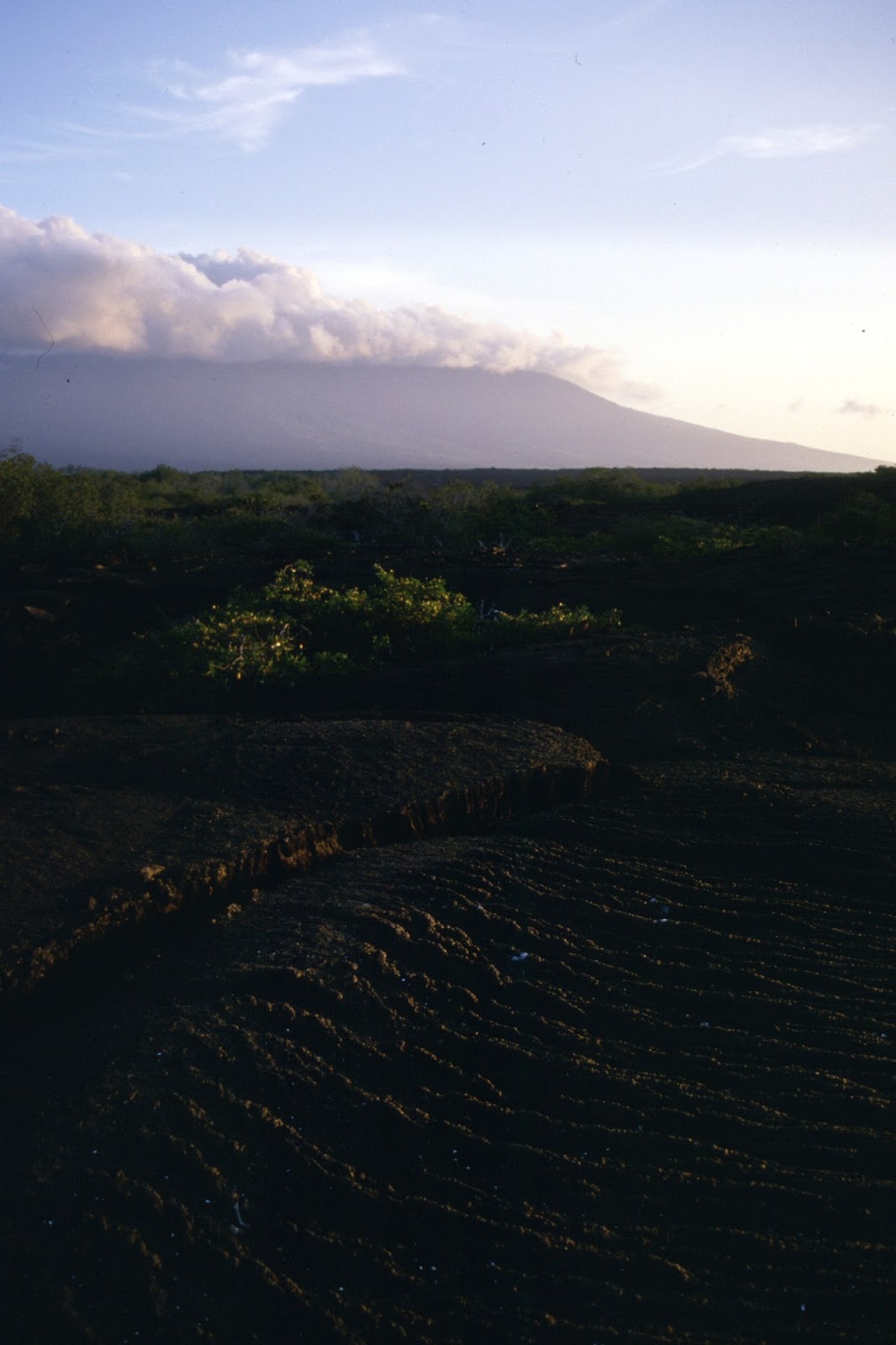
All of the Galapagos Islands were formed by volcanic eruption, and Isabella and Fernandina consist of, collectively, 7 volcanic peaks; the one on Fernandina is the youngest and most active, and last erupted in ’95. The ground in most places we hiked consisted of one of two forms of gunmetal grey-black volcanic rock: slabs and chunks of flat-topped, layered rock, grinding and clinking against one another like giant shards of broken ceramic as we walked over them; or longer, less fragmented stretches of parallel ropey ribbons--this type is called pahoehoe; the other one I’ve forgotten. Most of the rock, especially the first type, is patterned with tiny air spaces left behind by rapid cooling--John says I may have this backwards, but we have no way to check at the moment, sorry. Most of the rock is basalt, formed by flowing lava rather than volcanic explosion, and this accounts for some of its more interesting features. One of them is the lava tube, big enough to walk through--we haven’t visited any yet, but may take our bikes to see some today--and formed, says the Visitors’ Center, by the rapid passage of large air bubbles through molten lava, or possibly, says our Lonely Planet guide, by the rapid passage of hotter, less viscous lava through an area already beginning to cool.


The beauty of the Galapagos for me lies in their vast, stark stretches of broken, black rock; silent but watchful volcanoes in the distance; episodic clusters of bright green-yellow foliage; their sparse but integr gs about removing sand and soil from our feet before returning to the boat. One island is home to the fur seals (though probably only by choice); another, the giant waved albatross; there are 11 subspecies of giant tortoise, each in its own location; and three distinct species of cactus also existed in discrete locations, by and large.


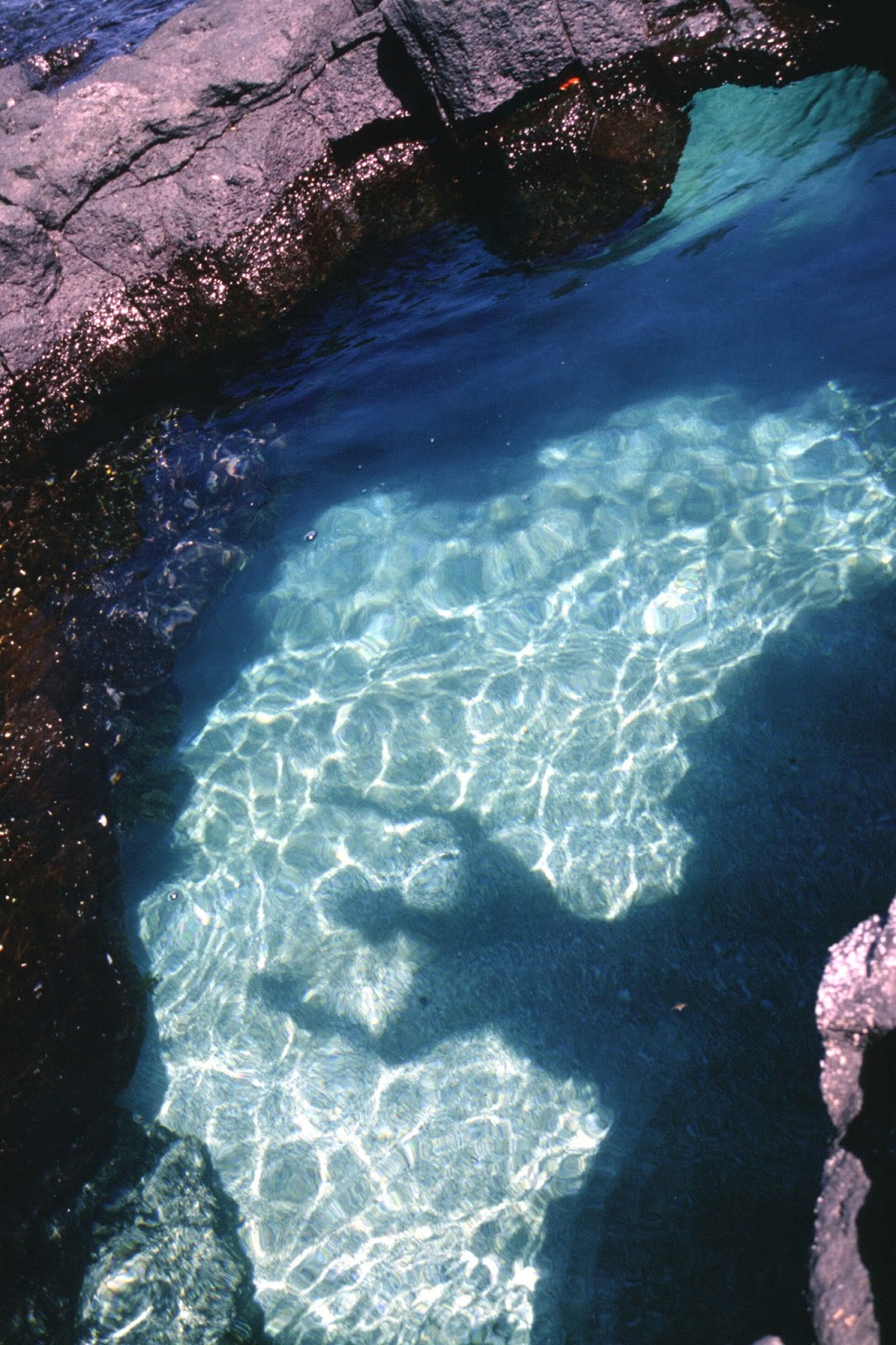
We also loved the snorkeling. On the first snorkeling trip we discovered that we were the only passengers with wetsuits, and the water was very cold. We stayed in for quite a long time, swimming around a small island, and when we couldn’t see any other snorkelers after a while, we occupied ourselves happily with a sea lion and her two pups, who swam with us and seemed to be showing off their large repertoire of underwater tricks. When the guide finally picked us up in an otherwise empty boat, we learned that the others, all freezing cold, had been back on the boat for some time. Over the next few days, we snorkeled at various beaches, where the water was warmer, but still we were happy to have brought the wetsuits, and the others continued to gaze longingly at them each time. We saw a few unusual varieties of tropical fish, and I saw one smallish shark and a couple of penguins underwater, but the best thing about the time spent in the water was being able to cool off--but not, of course, too quickly.






As I’m sure these updates make clear, what it is like changes all the time, and there are long periods of agonizing waiting, many afternoons spent chasing the tiny shade spots in the cockpit so as not to fry to a crisp, and would likely be considerable boredom if it weren’t for the vast numbers of books we brought with us. On the plus side, we’ve learned how to sail in open ocean, one of us has learned Morse code and how to cook, the other can fix almost anything electrical or mechanical on a medium-sized sailboat, both have learned Spanish (sort of), we’ve met all sorts of people we wouldn’t have otherwise, and we’ve learned everything we can about how things work in several different cultures already--and we’ve only scarcely begun to get anywhere. So we’re going to keep at it for a while…next update from French Polynesia!